2041 – The Year When Assam’s Demoraphy is predicted to change
April 18, 2026The demographic evolution of Assam is perhaps the most contested and socio-politically sensitive narrative in modern India. Unlike other states where demographic change is often viewed through the lens of developmental transition, in Assam, it is perceived as an existential struggle between “sons of the soil” and a “demographic invasion” with roots in colonial-era migrations. As the state moves toward a projected religious parity by 2041, the tilting of this demographic scale is no longer just a statistical observation but a primary driver of state policy, legal reform, and cultural anxiety.
The Quantitative Shift: From 1951 to 2041
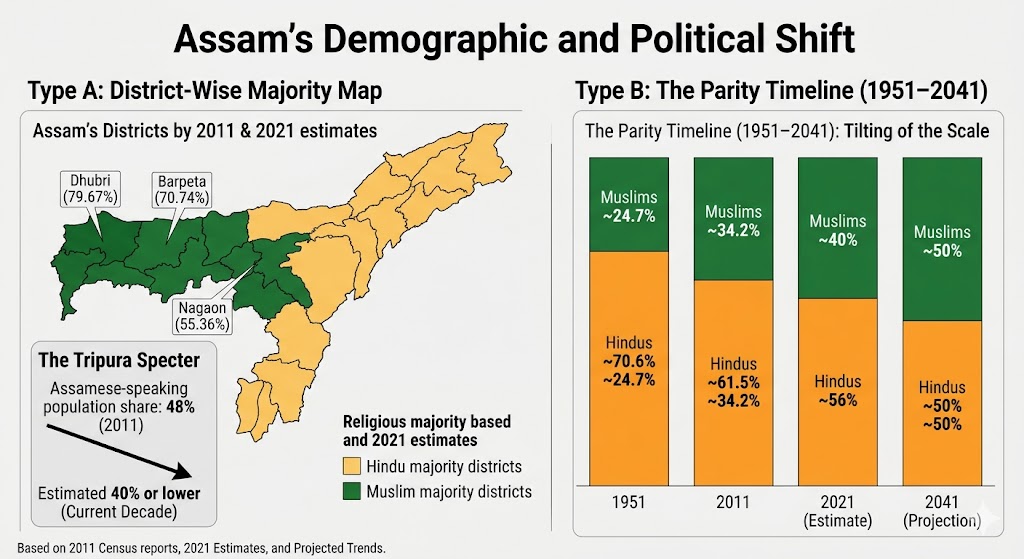
The baseline for Assam’s modern demographic identity was set in 1951, following the Partition of India. At that time, Muslims comprised 24.7% of the population. By the 2011 census, this share had risen to 34.22%, making Assam the state with the highest Muslim percentage in India after the reorganisation of Jammu and Kashmir. Recent 2021 estimates suggest the Muslim population has reached approximately 40%, totalling roughly 14 million out of a state population of 35 million.
Statistically, if current growth rates continue, projections indicate that the Hindu and Muslim populations in Assam will reach a 50/50 parity by approximately 2041. This shift is not uniform; it is driven by a stark growth rate differential. In the 2001–2011 decade, the Hindu growth rate in Assam was 10.9%, while the Muslim growth rate was nearly triple at 29.6%. Crucially, the state government distinguishes between “indigenous Muslims” (Goria, Moria, Deshi, etc.), who make up only about 3% of the population, and “migrant-origin Muslims,” who comprise the remaining 31–37%.
Land as the Pivot of Power and Conflict
In rural Assam, land is not merely a resource; it is the “pivot of power” and the physical foundation of cultural identity. The demographic tilt has manifested most visibly in changing land-use patterns:
- The Char Areas: The riverine islands (chars) of the Brahmaputra are now almost entirely inhabited by migrant-origin communities. This has created a geographical and social separation from the “mainland” Assamese society.
- Encroachment on Sattras: The Sattras (monastic institutions of the Neo-Vaishnavite movement) are the heart of Assamese culture. Extensive reports of land encroachment on Sattra properties by migrant populations have fueled deep-seated resentment.
- Forest and Government Land: As population density in migrant-heavy districts reaches extreme levels (e.g., Dhubri and Barpeta), the spillover into protected forest lands and government-held plots has led to aggressive state-led eviction drives.
The Linguistic Crisis and the “Tripura Specter”
For the Assamese people, the most profound fear is the “Tripura Specter”—referring to the neighbouring state of Tripura, where indigenous tribes were reduced to a small minority by waves of migration. Linguistic data suggests this transition is already underway in Assam.
- Linguistic Decline: The share of Assamese speakers in the state stood at 48% in 2011 and is projected to dip below 40% in the upcoming census.
- District Transitions: In 2001, there were 6 Muslim-majority districts; by 2011, this rose to 9; currently, estimates suggest 11 of Assam’s districts have a Muslim majority. In some constituencies, the Hindu population has seen a negative growth rate of up to 48% over the last century.
Political Maneuvering: Delimitation as a Safeguard
The realisation that “numbers decide power” in a democracy has led to a radical shift in administrative strategy. The 2023 Delimitation Exercise was a direct response to this demographic tilting. By redrawing the boundaries of electoral constituencies, the state government explicitly sought to protect the “political rights of indigenous people”.
- Constituency Redrawing: Large Muslim-dominated pockets were “packed” into fewer seats to prevent them from influencing a wider number of constituencies. For example, in the Barpeta Lok Sabha seat, the Muslim electorate was reduced from 60% to 35% through redrawing, effectively ensuring the seat remains under indigenous influence for the foreseeable future.
- Reserved Seats: The number of Assembly seats reserved for Scheduled Castes and Tribes was increased from 24 to 28 to anchor political power in historically indigenous hands.
Conclusion: The Aggravating Scale
The demographic change in Assam is viewed not as a standard population shift, but as a “demographic invasion” that threatens to erase the linguistic and cultural footprint of the indigenous population. If the scale continues to tilt toward parity, the existing social and political tensions are likely to aggravate. The state currently exists in a state of high friction, where administrative tools like the National Register of Citizens (NRC), the Assam Accord (1985), and delimitation are used to provide temporary buffers against a permanent statistical shift. Without a long-term stabilisation of growth rates and a resolution to the land-ownership crisis, Assam remains a “laboratory” for the complex challenges that arise when a majority community fears it is on the verge of becoming a minority in its own homeland.
We welcome your comments at letters@friedeye.com