Himanta Biswa Sarma’s Second Term: Balancing Ideology, Austerity, and Assam’s Realities
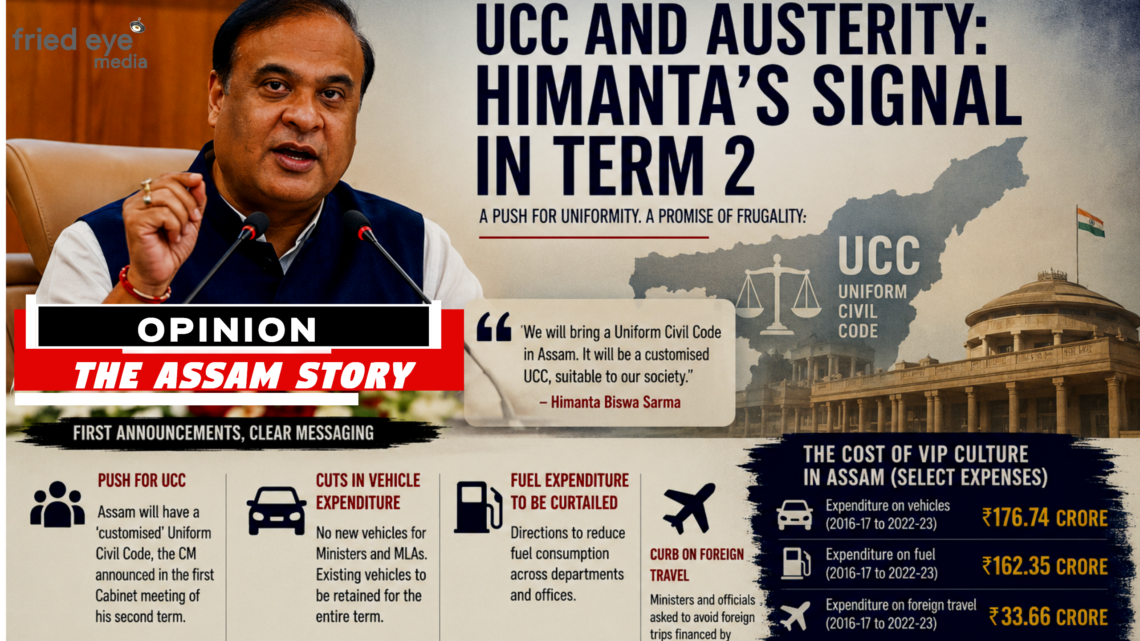
May 13, 2026Himanta Biswa Sarma wasted no time defining his second term as Assam’s Chief Minister. Within hours of his first cabinet meeting on May 13, 2026, he unveiled bold moves: tabling a customised Uniform Civil Code (UCC) bill on May 26 and imposing a six-month austerity drive, slashing fuel use by 20%, freezing new vehicle buys, and curbing ministers’ foreign travel. These aren’t just policy tweaks—they’re a deliberate signal of “Sarma 2.0,” blending cultural assertiveness with fiscal restraint. Yet, as a seasoned observer of Northeast politics, I see both promise and pitfalls. Sarma’s strategy energises his base while nodding to public frustrations, but it risks alienating minorities and fizzling into optics if not sustained.
The UCC: Reform or Polarising Symbol?
Sarma’s UCC pitch is tailored for Assam’s mosaic. Exempting tribal communities under the Sixth Schedule and sparing religious rituals, it zeros in on polygamy bans, women’s inheritance rights, marriage registration, minimum marriage age, and live-in relationship rules. This isn’t Uttarakhand’s blanket model; it’s a pragmatic sidestep around the Northeast’s tribal identities, framing UCC as social justice rather than cultural overreach.
Praises flow easily here. Sarma shows shrewd navigation of Assam’s fault lines—deep ethnic diversity meets BJP’s national ideology. By de-polarising the code, he positions it as progressive equity, potentially curbing exploitative practices without igniting tribal backlash. Politically, it reaffirms his brand: direct, unapologetic signalling to Hindu voters who propelled BJP’s 2026 win, adopting the manifesto as a blueprint.
Critics, however, smell selective targeting. Opposition voices, including Congress and AIUDF, decry it as a majoritarian jab at Muslim personal laws, especially polygamy clauses amid Assam’s history of citizenship tensions. Exemptions for tribes raise hypocrisy charges—why shield some customs but not others? Implementation could spark legal battles or social unrest, testing Sarma’s claim of “customised” sensitivity. If it devolves into identity warfare, it undermines his efficiency narrative.
Austerity Drive: Smart Optics or Genuine Shift?
The fuel cuts and convoy trims hit a raw nerve. With Assam’s 2024-25 budget at ₹1.41 lakh crore and volatile oil prices from West Asia strife, targeting ministerial extravagance—potentially saving crores on fleets and travel—projects a “war-time” mindset. Switching to EV rentals and virtual meetings aligns with Green Budget 2025-26’s ₹24,607 crore sustainability push, appealing to inflation-weary middle-class voters tired of VIP culture.
Supporters hail it as leadership by example, making abstract fiscal prudence tangible. Historical CAG audits across states flag crores in vehicle excesses; Sarma’s 20% slash could redirect funds to his 2 lakh jobs pledge, burnishing “double engine” governance.
Sceptics point to precedents: Indian governments often launch austerity fanfare that fades. Will convoys really shrink amid security needs? Departments might game metrics, burying savings in vague heads. Critics like CPI(M) argue it’s a deflection from core issues—floods, unemployment, debt—while ignoring private sector waste. If ministers dodge via loopholes, it becomes a PR stunt, eroding trust in a state where public resentment simmers.
Striking a Delicate Political Balance
Sarma masterfully pairs identity (UCC) with governance (austerity), energising ideologues while reassuring taxpayers. His first term built him as BJP’s Northeast powerhouse; this sets Assam as an assertive model beyond the Hindi belt. Early wins like manifesto adoption signal continuity with electoral promises.
Yet balance is fragile. UCC risks deepening communal divides in a border state wary of migrants. Austerity demands iron discipline over five years, not six months. Sarma faces flak for past controversies—evictions, rhetoric—that paint him aggressive. Success hinges on delivery: jobs created, codes passed without riots, budgets balanced.
The next six months loom large. If Sarma sustains this, Assam could blueprint lean, reformist rule. Slip, and it exposes the gap between bold starts and gritty execution. In Assam’s volatile arena, ideology thrills but pragmatism endures.
We welcome your comments at letters@friedeye.com