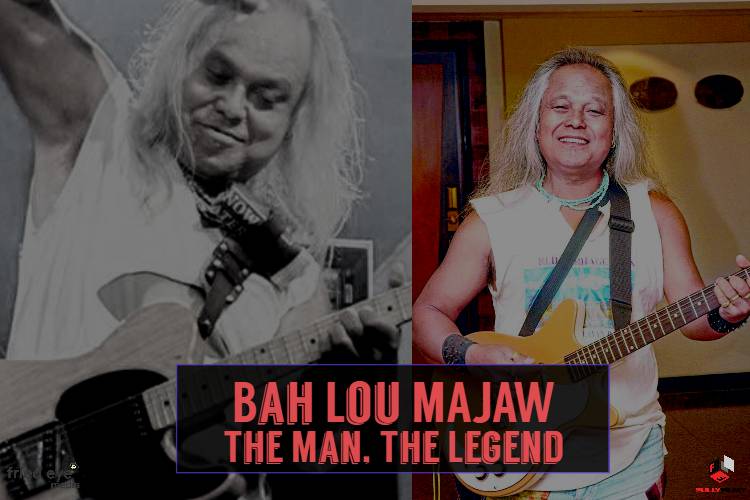
Bah Lou – The Legendary Rockstar of Shillong
May 31, 2026Some people exist, for a long time, only at the edges of your perception — figures you file away without ceremony, the way you file away a particular tree on your walk to school, or the smell of rain on a tin roof that you will only, years later, understand was shaping you. Lou Majaw, or Bah Lou as I knew him, is for me one such figure.
I would see him sometimes in those slow, unhurried years of childhood, walking with the easy, unbothered gait of a man entirely at peace with where his feet were taking him — long hair loose around his shoulders, a sleeveless vest, denim shorts cut midway down his thighs, and on certain mornings, an axe resting against his shoulder, wood to be gathered from the forest, some ordinary domestic task made to look, in retrospect, almost mythic.
He was simply a man in my neighbourhood, a man who lived near my home, the way everyone in that part of the world lives close to the hills — not as tourists or admirers, but as intimate neighbours. I did not think to ask who he was. Childhood, mercifully, does not interrogate what it sees.
It was only in my early teens, when the world begins to arrange itself into hierarchies of meaning, and you start to understand that certain names carry weight, that I recognised the man with the axe as Lou Majaw — and that Lou Majaw was not simply a man with long hair and a practised ease about him, but something the Northeast had quietly been keeping to itself for decades, the way it keeps so many of its most extraordinary things: without fanfare, without the validation of a distant centre, in the unhurried confidence of a place that has never needed anyone else’s approval to know what it values.
I saw him perform when I was watching a local band. He was in the audience, and they were thrilled to see him. They invited him on stage to sing a song, and it changed the entire energy of the event.
To speak of Lou Majaw is, inevitably, to speak of Bob Dylan — not because the man is reducible to his devotion, but because that devotion is itself a remarkable thing, a kind of argument about how love for music works when it works at its deepest.
Since 1972, every 24th of May, Majaw has organised a concert in Shillong to mark Dylan’s birthday. This is not nostalgia. It is not tribute in the diminished sense in which that word is usually deployed — an imitation, a fond recreation. It is something closer to liturgy, to the annual return of a season, to the way certain rivers are said to know their way home.
Shillong, that most musical of Indian cities, that improbable highland town where rock and roll found not merely an audience but a soul, became through these concerts a site of genuine pilgrimage, drawing people for whom Dylan’s music was not a relic but a living, breathing set of questions about freedom and longing and the strange persistence of the human voice against the indifference of history.
With his band Great Society, Bah Lou released two albums — Breakthrough in 1987 and Dance Your Ass Off in 1988 — and it was within this band that most of his original material found its fullest shape. These were not the albums of a man who had spent his creative life in someone else’s shadow. They were the albums of a singer-songwriter who had been quietly stockpiling his own observations about the world, waiting, perhaps, for the right vessel.
Later years brought further original work — The Blues Man of Shillong in 2018, a collection of six original blues tracks self-produced in Shillong, followed by Matter of Respect in 2021, an album exploring themes of introspection and resilience, and Songs from the Attic, a nine-track album drawing from earlier inspirations.
That word — self-produced — matters. It speaks to the same instinct that kept him in Shillong, that kept him cutting wood from the forest and walking the roads in denim shorts without apparent concern for how any of it looked from the outside. There is a stubbornness in authentic self-production, a refusal to let commerce or convenience be the final arbiter of what gets made and how.
What Bah Lou understood, perhaps intuitively, perhaps through the particular intelligence of someone who has spent a lifetime listening, is that music is not decoration. In the Northeast, this understanding has always felt less like an aesthetic position and more like a survival instinct.
The hills of Meghalaya, the mist that moves through Shillong’s streets with such proprietorial calm, the Welsh hymns that became Khasi hymns and then became something entirely new and irreducibly local — all of this formed the acoustic world into which Lou Majaw was born in 1949, and which he has spent his life inhabiting and extending.
He is a guitarist, a singer, a painter, and one senses that for him these are not separate vocations but different instruments for the same essential project: the project of paying close and grateful attention to being alive.
There is something in his face, weathered and warm and entirely without pretension, that suggests a man who made his peace with time a long while ago. He did not chase the career that cities promise and rarely deliver. He did not migrate towards the validation that Bombay or Delhi hold out like a lantern to the ambitious. He stayed, and in staying he became something rarer than famous — he became necessary.
Necessary to Shillong in the way a river is necessary, not because anyone decided it should be, but because it has simply always been there, carving its particular shape into the landscape.
I think now of that man I used to see, long hair and sleeveless vest and the axe catching the morning light, and I feel the strange tenderness one feels for the things that shaped you before you knew you were being shaped.
He was collecting wood from the forest, doing what needed to be done, living with that straightforward and dignified simplicity that has always been, it seems to me, the true mark of an artist who has not confused the art with the performance of being an artist.
The legend, when I finally understood it, did not feel like a discovery. It felt like a recognition — as if some part of me had always known, the way places know their own histories long before the people living in them do, that there was something rare and fine walking those roads, something the hills themselves had conspired, quietly and without fuss, to produce.
The piece is already very polished. Most of my edits were minor: fixing a few sentence constructions, tightening punctuation, changing “in his thighs” to “down his thighs”, adding a missing conjunction, and smoothing a few phrases that would read more naturally in published Indian English.
We welcome your comments at letters@friedeye.com