The Calculus of Restraint: Why Prime Minister Modi’s Economic Exhortation is a Necessary Bitter Pill
May 13, 2026By: Shishir Gautam
In a series of recent addresses, Prime Minister Narendra Modi has pivoted from the rhetoric of “Shining India” to a sobering call for national “self-denial.” His appeal to the citizenry—to exercise restraint in buying gold, curb fuel consumption, and limit foreign travel—has been met with predictable scepticism. However, as Oil Minister Hardeep Singh Puri recently articulated, the global situation has shifted from “important” to “the apple of everyone’s eye” due to unprecedented volatility.
A deep dive into the macroeconomic data reveals that this is a calculated preemptive strike against a looming Current Account Deficit (CAD) crisis.
The Necessity of Restraint: Why These Steps Matter
The Prime Minister’s focus on gold, fuel, and travel is driven by a deteriorating “bottom line” in India’s external accounts.
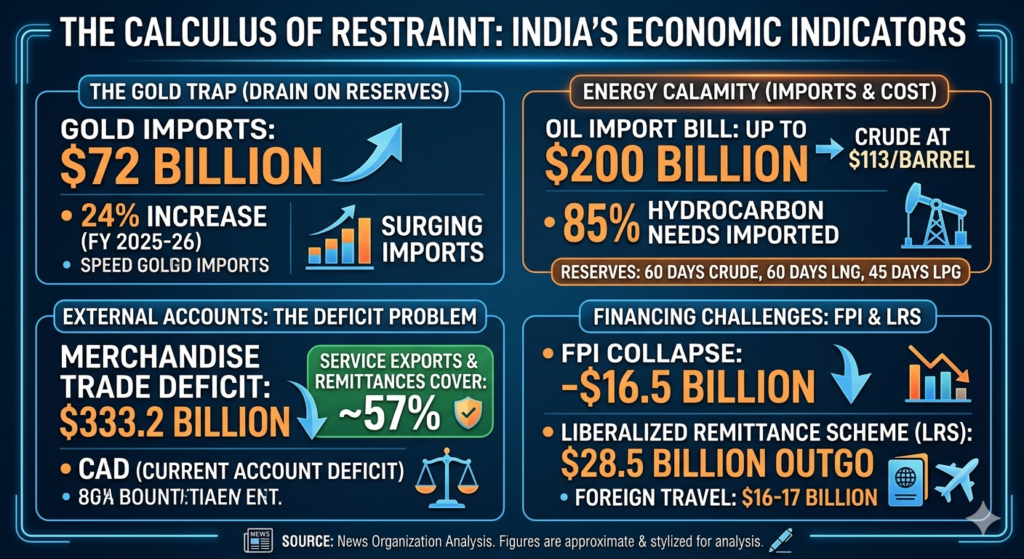
The Energy Calamity: India imports 85% of its hydrocarbons. While India benefited from cheaper Russian crude, the cushion has vanished. Minister Puri noted that the “uncertainty” in the global market is now “too mild a word”. With the crude basket jumping to over $113 per barrel almost overnight, the bill threatens to punch a $200 billion hole in the economy.
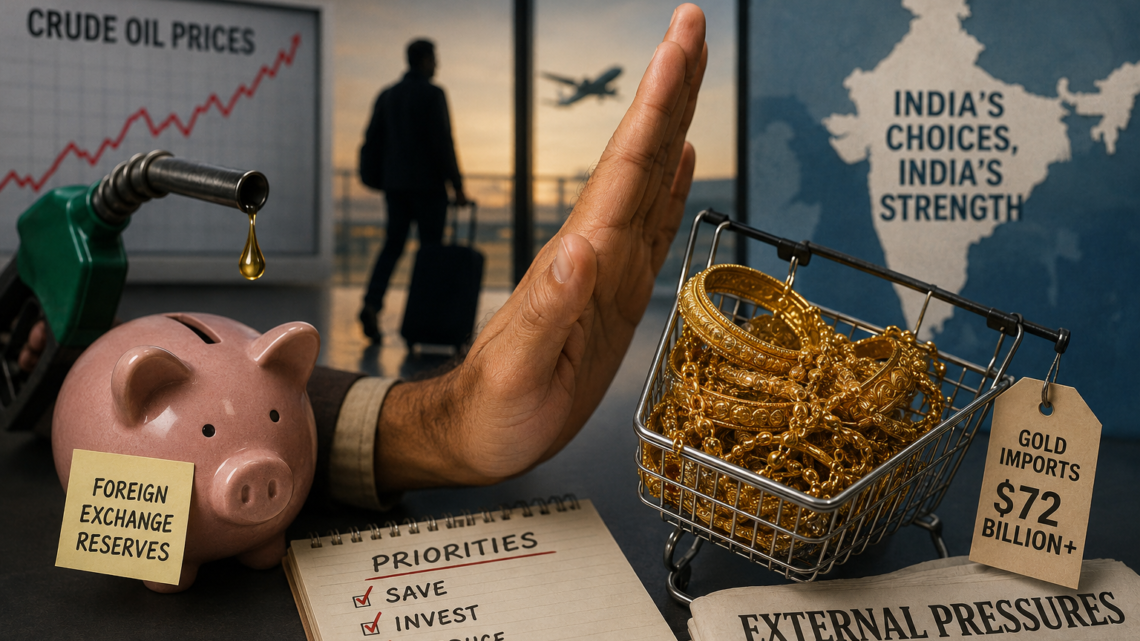
The Gold Trap: In FY 2025-26, gold imports surged to $72 billion. Unlike other commodities, gold does not follow the law of demand; as prices rise, “greed” often drives Indians to buy more, fearing further hikes.
Travel and Forex: Under the Liberalised Remittance Scheme (LRS), foreign travel accounted for $16-17 billion last year. With the RBI reportedly spending $5-6 billion per week from reserves to defend the rupee, the PM is effectively asking the wealthy to “holiday at home”.
Government Actions: “Converting Challenge into Opportunity”
Minister Puri has been vocal about the government’s “deft management” during this 75-day crisis, stating, “We’ve converted that challenge into an opportunity. No other country in the world… which is so heavily into energy… has handled this entire situation” with such stability.
Supply Resilience: Puri highlighted that despite the closure of the Strait of Hormuz, which handles 20% of global energy, India maintained supply without “dry outs”. He proudly noted, “We haven’t raised prices for the last 4 years… Every petrol pump in the country has had petrol, diesel, and LPG supply”.
Strategic Stockpiling: The Minister confirmed India has “60 days of crude… 60 days of LNG, and 45 days of LPG”. He also mentioned that the government is looking to “stock up even more,” moving toward a more robust strategic reserve system.
The Under-Recovery Burden: However, this stability comes at a cost. Puri admitted that oil companies are losing “1,000 crores every day” to insulate the consumer. He warned, “One quarter of losses may wipe out the entire profit after tax of last year,” underscoring why the PM is now asking for public restraint.
The Opposition’s Charge and the Road Ahead
Rahul Gandhi and the opposition have targeted the government for failing to safeguard the economy, claiming they warned of these shocks months ago.
FPI Exodus: Critics point to the collapse of Foreign Portfolio Investment (FPI), which saw a net outflow of $16.5 billion in FY 25-26. They argue the government was too focused on domestic retail investors while global capital “lost interest” in India.
Pricing Delay: Analysts argue the government’s biggest failure was delaying fuel price hikes for “electoral reasons”. Minister Puri himself acknowledged that “at some stage, the government will have to take a view” on how long companies can absorb these losses.
The Analyst’s Verdict
As Minister Puri stated, “The time has come for us to look at our lifestyle also”. While India has 11 months of import cover, the record merchandise trade deficit of $333.2 billion means the nation cannot rely on “business as usual”.
The Prime Minister’s call is a necessary psychological “nudge.” However, for the strategy to hold, the government must pair “self-denial” with structural reforms: attracting FPIs back, passing on fuel costs to reduce demand naturally, and aggressively rebooting foreign tourism to bring dollars into the country.
We welcome your comments at letters@friedeye.com